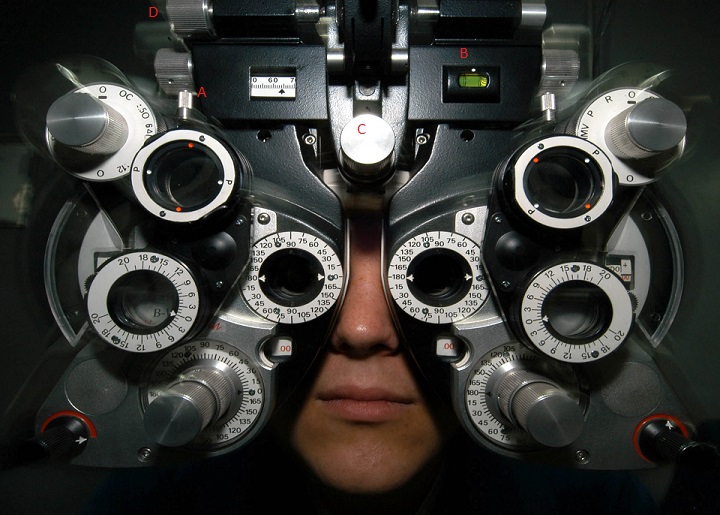
The correct choice is the control that adjusts the forehead rest. The forehead rest is the pad the patient's brow presses against, and it sets the vertex distance. Vertex distance is the gap between the back of a lens and the front of the eye. Setting the forehead rest the same way for every patient keeps that gap the same every time.
Vertex distance matters because it changes the effective power of a lens. A vertex distance of 13.5 mm is considered average, and real fits run from 5 mm to more than 26 mm. For a weak prescription, a small change makes no difference the patient can notice. For a strong prescription, a small change makes a large, noticeable change in both the sphere and the cylinder power. That is why the number is recorded for high powers. As a rule of thumb, prescriptions of 5 diopters or less (some authorities say up to 7) do not need this correction. Glasses fit at a different vertex distance than the refraction will not match the trial result. The patient then says the new glasses feel wrong, even though the written prescription is right.
Set the forehead rest first, leave it there, and write down the vertex distance for strong prescriptions. Frames should sit close to the eye, without the lashes touching the lens. Knowing what vertex distance is and why it must stay constant is a core part of the COA refraction content area.
Incorrect Answers
- A. This is not the forehead rest. Controls that swing the two lens openings inward set convergence or pupillary distance, which is side-to-side alignment, not distance from the eye.
- B. This is not the forehead rest either. Parts that show the instrument is level and not tilted say nothing about how far the lenses sit from the eye.
- D. This is also not the forehead rest. Knobs that change the angle or height of the instrument move it, but angle is not the same thing as vertex distance.
Testing Pearls
- Vertex distance is measured from the back of the lens to the front of the eye.
- 13.5 mm is the average vertex distance; the usual range is 5 mm to 26 mm.
- Vertex distance matters most for high-powered lenses, above about 5 diopters.
- Fit frames as close to the eye as possible without the lashes touching the lens.
- Changing vertex distance changes the effective power of the sphere and the cylinder.
References
- American Academy of Ophthalmology. Ophthalmic Medical Assisting: An Independent Study Course. Chapter 12, Fundamentals of Practical Opticianry.
- American Academy of Ophthalmology. Ophthalmic Medical Assisting: An Independent Study Course. Chapter 5, Optics and Refractive States of the Eye.